It is especially suitable for automated intelligent devices or systems that require both millisecond-level deterministic control and local data processing, intelligent analysis, or lightweight AI inference.
According to the EdgePLC BL237 Series Industrial AI Edge Controller Technical Specification, the core value of this product lies in its deep integration of traditional PLC real-time control capabilities with AI edge computing. It is especially suitable for automated intelligent devices or systems that require both millisecond-level deterministic control and local data processing, intelligent analysis, or lightweight AI inference.
Below are several typical types of automated intelligent devices and application scenarios that can fully demonstrate the value of its "edge computing + AI integration".
1. Mobile Robots (AGV/AMR)
-
Pain Points:
-
Need real-time control of motors, steering wheels, obstacle avoidance sensors.
-
Need to process visual data (e.g., QR code/marker recognition, person/object detection) for autonomous navigation and obstacle avoidance.
-
Traditional solutions often require a PLC (for control) + an industrial PC (for vision) → high cost, large size, uncertain communication delay.
-
Value of BL237:
-
Unified control & compute: Single device achieves motor real-time control (EtherCAT/IGH master) + YOLOv5/8 object detection (1 TOPS NPU).
-
Low latency: AI inference results can directly trigger control logic (e.g., slow down immediately when a person is detected) without cross-device communication.
-
Compact integration: DIN35 rail mounting fits the tight space of AGV/AMR.
2. Intelligent Vision Inspection Equipment (e.g., online quality inspection, OCR recognition)
-
Pain Points:
-
Need to trigger cameras and lights, and determine product pass/fail in real time.
-
Traditional vision systems upload images to an industrial PC or cloud → network latency affects production line cycle time.
-
Control logic (reject, alarm) requires a separate PLC.
-
Value of BL237:
-
Real-time edge inference: Built-in NPU supports TensorFlow/PyTorch models, enabling real-time defect detection on 1080P video streams.
-
Synchronized control & vision: Complete the entire workflow "trigger camera → AI analysis → control cylinder rejection" on the same device, achieving millisecond-level latency.
-
Protocol conversion & upload: Send inspection results to the cloud via MQTT, while controlling downstream equipment via EtherCAT.
3. Energy Management Controller (EMS) for Energy Storage Systems (ESS)
-
Pain Points:
-
Need to collect battery voltage, current, temperature (PT100/TC), and control PCS, BMS in real time.
-
Need to predict load and optimize charge/discharge strategies based on historical data (AI requirement).
-
Traditional EMS uses PLC or MCU for control, lacking local data analysis and optimization capabilities.
-
Value of BL237:
-
Local AI prediction: Run load prediction models locally (train or infer) to dynamically adjust charge/discharge strategies, avoiding dependence on the cloud.
-
Multi‑protocol access: Supports CAN (battery), RS485 (meters), EtherCAT (PCS) for data fusion.
-
Remote maintenance: Built‑in BLRAT secure channel enables remote debugging and upgrades for remote energy storage stations.
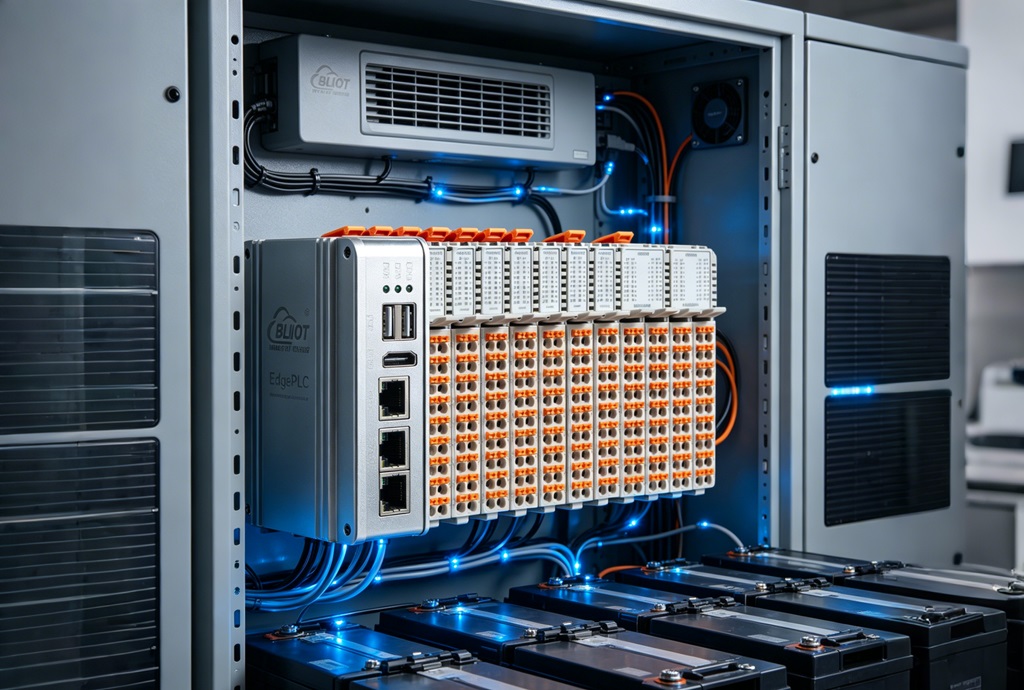
4. Edge Control Nodes for Smart Production Lines (e.g., assembly, packaging, welding stations)
-
Pain Points:
-
Need to control multiple cylinders, motors, sensors (dense DI/DO/AI/AO).
-
Need to exchange production data with MES and have certain equipment self‑diagnosis capabilities.
-
Traditional PLCs have fixed logic, making it difficult to calculate OEE in real time or predict equipment health.
-
Value of BL237:
-
Edge data processing: Use Node‑RED or Python to clean and aggregate production line data in real time, calculate OEE and cycle time.
-
Lightweight AI diagnostics: Run vibration analysis models to predict motor or bearing faults, triggering maintenance in advance.
-
Flexible orchestration: Supports OpenPLC/NEXPLC/CODESYS, while running Docker containers to extend functionality.
5. Intelligent Gateway Device (protocol conversion + local decision making)
-
Pain Points:
-
Connect to various brands of PLCs, instruments, drives (Modbus/Profibus/EtherCAT, etc.).
-
Need local complex rule‑based decisions, not simple forwarding.
-
Traditional gateways have little computing power for local closed‑loop control.
-
Value of BL237:
-
Protocol factory: Built‑in BLIoTLink supports bidirectional conversion of multiple industrial protocols.
-
Local closed loop: Collected data directly runs Python scripts or Node‑RED flows for coordinated control (e.g., when a parameter exceeds a limit, immediately close a valve via Modbus).
-
Cloud‑edge collaboration: Only aggregated results or abnormal events are uploaded to the cloud, greatly reducing cloud load and bandwidth costs.
Summary: Key Feature Combinations That Best Demonstrate Its Value
Conclusion: The BL237 is most suitable for scenarios where control latency cannot be tolerated, yet edge‑based data value conversion is desired. It is particularly effective in replacing the traditional combination of "PLC + thin client/industrial PC", offering significant advantages in cost, size, reliability, and development efficiency. If you are designing products for smart manufacturing, energy management, or mobile robots, this controller is a worthy computing and control core platform.


